






















Wadsworth City Schools, WCS, is currently working on passing a levy that will get the schools out of its deficit spending, which could cause a potential deficit of $6.7 million during the 2027-2028 school year. WCS’s Board of Education will present the four-year financial forecast, or budget, for the 2028-2029 school year on Feb. 9, 2026. The budget will show the expected revenue and spending.
“What deficit spending means is… you are spending more money than you are bringing in,” said Douglas Beeman, WCS treasurer. “That is where we are right now, we are spending more money per year than we are bringing in revenue.”
Even though WCS is losing money they still have money in their reserves, which makes it a deficit spending instead of a deficit. A deficit would be if the schools would not be able to pay the next utility bill. A deficit is a possibility depending on what Wadsworth residents vote for on the next levy. The levy will be released on the May 2026 Ballot.
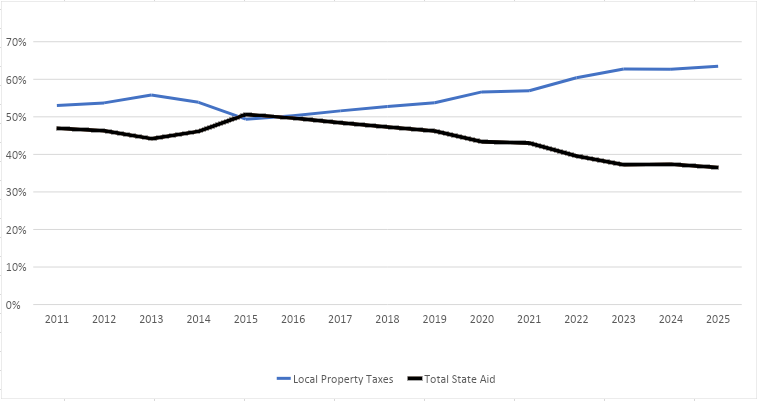
“Less than half of the school’s revenue (35%) comes from the State, while 65% comes from local property taxes,” Beeman said. “In 2015, half of the district’s revenue came from the state, with the other half from local property taxes. The shift over the past ten years demonstrates that the state legislature has not funded public education as it did in 2015. The attached chart shows the shift in revenue away from the state and onto local property owners.”
The stagnant amount WCS gets from property taxes is another reason why the deficit got so big. Property taxes are the biggest revenue source for WCS, but since the cost of everything has gone up, WCS has not been able to get enough money from taxes. This means the two main ways that WCS gets its money has not been funding it enough since the 2023-2024 school year, creating this $6.7 million deficit.
Due to this, the school board decided to change the levy from property tax to income tax. Wadsworth citizens will have the chance to vote on whether they want to pay an income tax of 1.5%, instead of a property tax on the upcoming levy. This way the WCS will be able to get more money from the income tax and help to pay off its $6.7 million deficit.
“We are making the appropriate spending cuts, we have future cuts that will be, I think it is close to $500,000 that we have already been exploring,” said Tim Beck, President of the WCS Board of Education. “We hope to show the community that we are taking this very seriously, that we are cutting spending in the ways that we feel are appropriate, up to $500,000, yet also … asking for a levy, that we are showing that we are trying to be responsible with the money that is allocated to us, either from the state or local community.”
If the deficit is allowed to continue to grow unbothered until the next levy, then the amount will reach $16 million.
“There is a group already formed from the last levy called Friends of Wadsworth City Schools, and that will get people in the community that care about schools, parents, probably some staff, people who are just passionate about education,” Beeman said. “Hopefully we will come together and they will work on getting the message out.”
Around 80% of WCS spending goes to employee salaries and benefits.
“WCS is cutting back on the biggest cost by not replacing retirees and certain resignations,” Beeman said. “For example, eight teaching positions were not replaced after the 2024-25 school year.”
If the levy does not pass then the Board of Education will have to let about 20 teachers go. They would also have to let go of various other employees. The board is not planning on cutting any programs.

Judy • Mar 23, 2026 at 4:15 pm
I don’t understand why parents of enrolled students aren’t assessed a fee, based on income.